Sharing my experiences to help others.

Sunday, May 29, 2011

Bee Transport

Last evening, after the majority of bees returned from foraging, my dad and I sealed the hive for its move to Johnstown. We ensured there were no gaps in the top-bars that would allow unwanted back-seat drivers. The holes were corked and the hive was carried to the van. I loaded up all my things and took the 15 min. drive to their new home.


Even though I found the queen yesterday, my concern was that she had not adequately mated. We will soon see if my fear is warranted. With the hive being so close to Lynd's farm and in an area where there are bound to be wild swarms, she should be able to adequately complete any maturing well.

Since all the Johnstown set up was in the darkness, this morning I was able to utilize the sunlight. I moved the top bars from the swarm box to the supers of a Langstroth body. The top-bars were about an inch too long to allow the hive's closure. We chose to trim them back with a Japanese pull saw. A second hive body was placed above the top bars with the materials Doug purchased. It will be sometime until the drawn top-bars can be removed from the hive (next year).

With the morning sunlight I was also able to see FRESH EGGS! I will return to this hive in a week to help Doug monitor the progress. We should see a lot of new comb as they have a hive-top feeder with 1:1 simple syrup.

Stay tuned!

Friday, May 27, 2011

"I once was lost, but now am found" - The Queen(s)

Last evening, Doug (a co-worker of my dad) came to visit the hives. With the growing population of bees in my parents' backyard, it is important to keep good relations with the neighbors! To help cut down on any bee-nuisances, we decided to relocated one of the hives. Doug lives in Johnstown, OH near Lynd's Fruit Farm. His home backs up to 37 acres - near many orchards. This will be a perfect spot for a hive.

While showing Doug (virgin beekeeper) my hives I spotted the Queen in one of my new hives! The behavior by the hive just days before could now be explained perfectly. This native Queen looked wonderfully healthy. I have not found any new brood production as of yet, but at least I know there is a Queen in there!

During my lunch break today, I went to check the swarm box (that I also believed to be without a Queen). Excellent news on this front as well; there are fresh eggs! Although I have yet to find Her yet, it is obvious there is a laying queen - incredible! Really! I will continue to search for her in the coming days before we take that hive to Johnstown.

"For his invisible attributes, namely, his eternal power and divine nature, nhave been clearly perceived, ever since the creation of the world, in the things that have been made. So they are without excuse." - Romans 1:20

Thursday, May 26, 2011

Vicious little boogers!

Good News: The two hives I thought didn't have queens have queens!
Bad News: I spent $42 and an hour and a half drive to find that out....

On Monday, I drove to Waldo, OH for two Queens. The hives they were for had become aggressive and had not created any new brood ... to me this signaled "We are without a queen!". When I returned to the hives with the new Italian queens, the bees looked apt at accepting them. They quickly gathered around her - even building comb off the queen cage.

Tuesday, I visited the new queens to release them. Well - this turned out to be quite interesting! IMMEDIATELY the bees pounced and began dragging her down in to the hive. I pulled one worker from her who had placed an entire wing from the Queen in its mouth! Luckily I was able to remove the aforementioned worker without damaging the wings. The marked queen proceeded to fly away from the apiary. Have you ever seen $21 literally fly away in front of your eyes... I did. This of course was the best move for the Queen - as she would have been killed if she remained in the hive.

The queen release in the 'swarm box' also appeared very promising. They did not attack her in the same manner - phew! Unfortunately, this morning when I went to check on her I noticed a ball of bees at the bottom acting very aggressive - crud.... Turns out the second Queen was at the center of the mob - being killed. Phooey....

Well what did all this tell me. The two hives that I purchased queens for already had queens! EVEN AFTER I literally combed the combs looking for the Queens. May frustration ensue...

Friday, May 20, 2011

The Swarm!

While I had the hive opened, to find the hatched queens, one flew on to my hand - very strange for a queen to be out of the hive! Suddenly she flew away and craziness ensued; it was like someone turned on a box fan in the hive. 
Maybe 3 minutes after this whirlwind, I heard some commotion above me. My parents' house have many tall maple trees, and the swarm relocated about 30 feet in the air. 


The newest "hive" with some original frames and
some of the collected swarm.

We relocated the top bars from the tub into a quickly assembled box.
The behavior below is a way for their scent to be fanned into the air.
Think of it as a scent magnet.

Monday, May 02, 2011

'Old Hive' Queen Larvae Developing

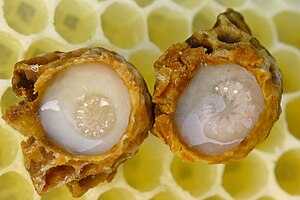
Without an established queen in the 'old hive' the bees are agitated and quite aggressive. Those guys go straight for the face! Until a new queen emerges in that hive this behavior will continue. However, on that front, we have great news. In at least two queen cups (for sure) I can see the curled larvae of a pre-queen in a pool of royal jelly. These cells have been upgraded from queen cups to Queen Cells.
Queen Larvae in Royal Jelly (Courtesy of Wikipedia) 


The nurse bees tend to these cells diligently, preparing the future leader of the hive with all the nutrients required for her busy life of eggs laying (~2000+ a day). This graphic below (age in days) has helped me to determine that these future queens were laid as eggs the middle of last week. In about four days I anticipate the queen cells to be capped, which will reliably show they are then 8 days old.


Courtesy of Glenn Apiaries 

Saturday, April 30, 2011

Artificial Swarm

With so many bees on the combs it took nearly 10 minutes to find the queen before a split could be accomplised. After finally locating her, I moved that comb (mainly drone brood) to the new hive in addition to some newly laid worker larvae, capped brood, and pollen/honey.

After placing the queen into the new hive, hardly any of the returning worker bees went to the queen! It took a good half hour before any 'old hive' bee visited the entrance holds of the 'new hive'. I quickly discovered why it was so important to place capped brood in the hive. As the new brood emerge they will take ownership of the hive, while the older bees remember their earlier lives in the 'motherland'. A few of the bees left the new hive, flew out, and flew into the old one; I guess old habits die hard!

Below are but a FEW of the 30+ queen cups (swarm cells) present in the hive.


Friday, April 29, 2011

Preparing to Swarm


I have been closely monitoring the hive after observing a large quantity of queen cups. The hive's population has increased exponentially since early spring, and it is obvious that they are preparing to divide (swarm). It has been very wet and cool in the region lately, and this is causing them to become stir-crazy and crowded. Every comb is covered to the brim with bees, and under many of those combs are capped brood. To combat this overcrowding, the hive prepares these queen cups and the current queen 'works out' to get her body ready to fly - something she hasn't done since her mating flight at 22-27 days old.

Queen and Drone: Mating Flight


Yesterday (April 28) I found at least four queen cups with EGGS! Swarming is evident and soon. I am thankful that my dad constructed a second hive as that will be used to complete an artificial swarm. This will be my first attempt at the technique which splits the hive. In the new hive will be placed the current queen, half the capped brood, larvae, honey and pollen, workers and nurse bees (which will be quite easy with it being chilly and damp outside). The key is to be sure that in this new hive are no queen cups. The old hive will have the queen cells (queen cups with eggs) that the nurse bees will rear.
Thursday, April 21, 2011

First Varroa Mite Sighting of the Season!


This beauty is the Varroa Destructor, enlarged to epic proportions! Today, as I went to the hive during my lunch break, I noticed a few drones on the ground (alive) struggling to flip off their backs.

Looking closer, I noticed something was definitely happening to the hive. This was an unmistakable sign of Deformed Wing Virus. With the remaining time before class, I suited up and went in! The remaining drones inside had fully developed wings, looked healthy, etc.


...and just when I was on the last frame, I noticed what looked like a red 'queen mark' on a worker. I quickly pulled the bee off the frame and found the little Varroa mite trying to hide.


Stay tuned to see if my treatment works.

Wednesday, April 20, 2011

B(ee) is for Beneficial

The media has brought awareness to the importance of the Honeybee and to a noticeable population decline. Apis Melifera is the pollinator of over $7 BILLION in agricultural products. With a decline in the Honey Bee, so goes our vegetation and domestic/international products. My little backyard-hive was quite helpful to the vegetable gardens around the neighborhood. We have received numerous reports from area homes having higher than normal yields.


Another CRITICAL element with retaining Honey Bee colonies is to keep a non-Africanized population in your area. Think Urban Sprawl - sort of. Low populations of native bees can allow Africanized bees to easily take over, ESPECIALLY in the southern United States. AHB

An Africanized honey bee (left) and a European honey bee work on a honeycomb. The Africanized bee, smaller than its European counterpart, has apparently now made its way into Georgia. SCOTT BAUER, USDA AGRICULTURAL RESEARCH SERVICE Extracted Link

Monday, April 18, 2011

Pollen Basket

When a honey bee visits flowers, it collects both nectar and pollen from the plant. Pollen is used as a source of protein for the hive. In order to facilitate transport, the bee compacts the pollen into the bristly hair of its back leg. The image below shows the tibia's hairs that allow for pollen collection.


Below are various pollen grains under a scanning electron microscope.
Author/Photographer/Artist: Dartmouth Electron Microscope Facility

Saturday, April 16, 2011

Discarding Pupae

In the image below, just left of center, you will see a open cell with a pupa in its 'purple eye stage'. Since the other brood cells surrounding this are capped (developing into adult bees), this is a sign to the beekeeper that there is something wrong with it and the bees will soon discard the pupa.

Here is a close up of a pupae in purple eye phase. 
(Image courtesy of http://www.caes.uga.edu/)

Sunday, April 10, 2011

The Hive is ACTIVE!

A peek into the top-bar hive. 


Look at all that capped brood! I lightly blew on the comb to get the bees to move, in order to take this shot. As you can see, the queen is laying a very strong brood pattern. In a few days, these bees will break through and start work inside the hive. 

The Queen

After the Queen lays the eggs, they develop into larvae (seen in the cells). When each larvae reach the appropriate stage, the nurse bees cap the cells (bottom left) for the larvae to develop into a pupa and emerge as an adult. 

The cell size is CRITICAL to the health of the hive. This comb is 100% natural; there is no foundation on which the bees have drawn the wax. Allowing the hive to establish their own cell size (something that cannot be done with 'store-bought' foundation) helps improve the hive's health. If the cells become too large mites and other parasites have opportunities to ruin the colony.


Landscape of the Comb